
Written by John Fleming
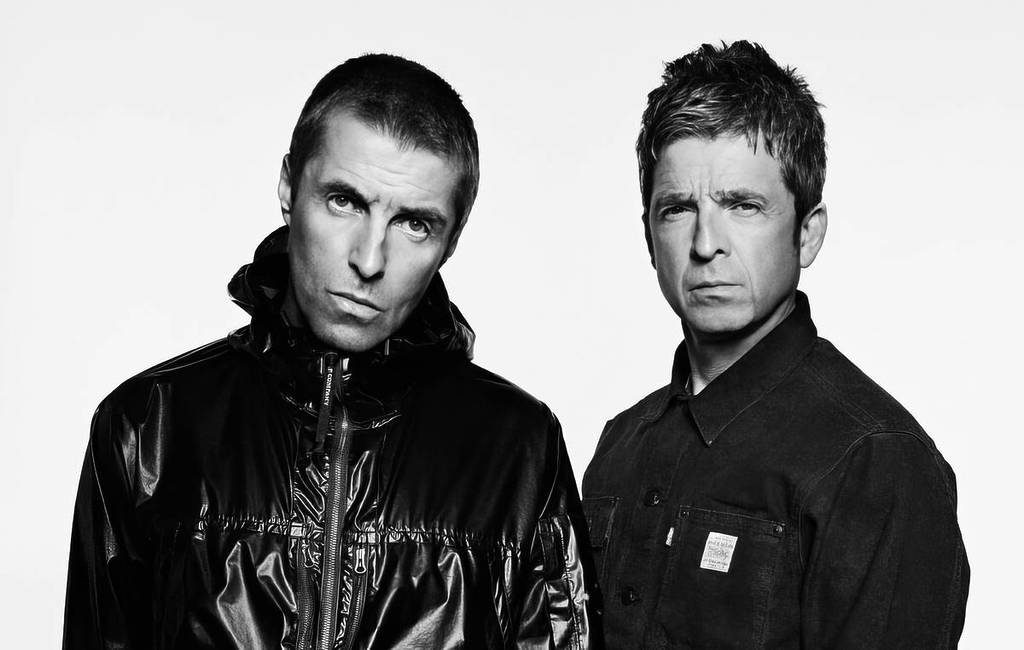
Credit: Simon Emmett
At one point during Oasis’s first concert on American soil since 2008, Liam Gallagher commented to the crowd about the elephant in the room – the band’s reputation as adversarial to American audiences. And while the reputation isn’t totally unfair, it did usually seem to be a practical matter for the band: why struggle to sell out arenas in America when you can easily sell out stadiums and large public parks in Europe?
But 31 years after their debut, and 16 years to the day after their breakup, Oasis was finally ready to truly take over America. And for one night in Chicago, they did.
I had my first sense of something truly special unfolding as my party got off the interstate and drove by Soldier Field, where a large crowd of fans had already gathered. There was a distinct hue of Manchester City blue, matching the preferred soccer team of the Gallagher brothers.
The band’s association with the club dates back to their heyday, when City typically struggled to remain in England’s Premier League. In the time since Oasis’s 2009 breakup, the club has become a juggernaut, winning eight Premier League titles and the 2022-23 European Champions League. This was the first sign that the concert would feel more like a sporting event than a concert.
Usually, there is an unwritten rule, which never made much sense to me, that one should not wear a band’s T-shirt at their show, but it became immediately clear that was not going to apply here.
Checking into the hotel, at least half of those in line were donning Oasis gear. In the elevator to our floor, a father with his (roughly) 10-year-old son told the story of how a reporter from the British tabloid The Sun had interviewed them about attending the show, while a mother and her teenage daughter discussed seeing Liam Gallagher perform at Lollapalooza 2017 in nearby Grant Park.
We didn’t spend much time in the hotel before heading to the concert – we had already become enamored with the energy surrounding it. We had specific seats, so we were not in a rush to get into the venue immediately, but we walked through 10s of thousands of camped-out general admission fans who eagerly discussed their favorite Oasis moments with strangers, who would giddily burst out into the chorus of “Don’t Look Back in Anger,” and who wore bucket hats like they were part of the work uniform. One particular fan warmed my sports-obsessed, St. Louisan heart – a guy in a custom St. Louis City SC shirt with the nameplate “MADFERIT” and the number 25.
At an outdoor bar on a beautiful late summer Thursday afternoon, sitting in front of a cover band that entertained the Oasis-centric crowd with a rendition of “Champagne Supernova” as well as “Ain’t No Rest for the Wicked” by that night’s opening act, Cage The Elephant, it was a markedly uncynical experience. Fans sang along to the Oasis cover, grateful for the effort. But they also sang along to covers of songs by Radiohead and The Verve, bands that alternated between being considered Oasis contemporaries or rivals but which, in the context of the night ahead, were all part of the experience.
Considering Oasis’s only previous times playing a U.S. outdoor sports stadium were two consecutive nights as an opener for U2 in 1997, it was almost certainly the most pro-Oasis gathering on American soil up to that point.
There was unquestionably a Chicago lean to the crowd – the anti-Green Bay Packers chants exiting the venue gave that much away – but it was a crowd from all over the world. Many had flown into Chicago for the occasion, from across America and from around the world.
When it was first announced that Oasis was reuniting for a 2025 tour, I assumed that I also would have to hop on a plane to attend it. I had no illusions of a St. Louis stop, but that they would stop in Chicago, a drivable trip, itself felt like an honor.
The crowd’s variance in age was wide. The most common fan, unsurprisingly, was the age of somebody who would have been a teenager in the mid-1990s. However, there were many young people who clearly would have been too young to remember a time when Oasis was releasing new music, and there were many fans who were in their 60s, a type for whom Oasis wasn’t their first favorite band but possibly their last favorite band.
The audience had plenty of musicians: the next night’s Soldier Field headliners, My Chemical Romance, confirmed their attendance, as did Deftones frontman Chino Moreno, among many others.
Cage The Elephant, not quite a stadium band but one capable of playing arenas or large outdoor amphitheaters, had the thankless job of playing an hour-long set before a crowd that had been waiting for a generation for the next band. But to their credit, their performance was exactly right for the moment.
Frontman Matt Shultz had the energy of somebody with a chip on his shoulder and an obligation to evoke an energy that Oasis could generate from a hungry crowd alone. But Cage The Elephant, depending on black and white video boards and a twilight that hadn’t quite given the stadium a sense of mystique, felt like a stadium band through sheer force of will.
When Oasis took the stage, they were not subtle. The opening video montage showed a series of headlines and social media posts announcing the tour, and while nobody in the audience needed a reminder, the reminder of “Guys, you’re about to see Oasis perform live in 2025; can you believe that?” was a sure way to hype up the crowd.
The band opened with “Hello,” a song which I don’t think is any fan’s favorite but which opens the band’s biggest album and includes the crucial “it’s good to be back” refrain, followed by “Acquiesce,” the beloved B-side that gives the Gallagher brothers an opportunity for call-and-response vocals.
I could quibble with the setlist. As a fan of their later work, the near-total exclusion of the band’s 21st century albums feels disappointing. Only “Little By Little,” my default answer for least favorite Oasis single but one which admittedly sounds much better live, cracked the setlist.
However, I also don’t know what songs I realistically would have wanted to replace. Oasis played the big hits, but they also performed tracks that they had mostly ignored since the 1990s, such as the blistering punk of “Bring It On Down” and the psychedelic grandeur of “D’You Know What I Mean?” The tour setlist includes “Fade Away,” a B-side that they hadn’t played live since 2002.
There was a largely unfair, straw man argument when the tour was announced that tickets would be gobbled up by people who only knew “Wonderwall” – the setlist was not designed for that hypothetical crowd.
Of course, Oasis did play “Wonderwall,” and it was a highlight. In contrast to the often-stripped down, often-Noel Gallagher sung renditions once Oasis seemed somewhat burned out on their biggest hit, they played a rendition faithful to the original, which highlighted what makes the song a genuine musical highlight of the band: complex and intricate drum patterns, a propulsive bassline and a tremendous string section. It was the arrangement of “Wonderwall” you give people who have been waiting a lifetime to hear it live, with the rest of the band bringing the heat: original rhythm guitarist Paul “Bonehead” Arthurs came back, while gifted latter-day members Gem Archer and Andy Bell returned, alongside talented American drummer Joey Waronker.
The arrangements across the board were quite tight: Noel hit every note of every guitar solo with precision. As much as a 1994 Oasis-style extended jam cover of “I Am The Walrus” would have been fun, this was not the kind of show most fans had waited for, and the band respected that.
When we returned to the hotel, the lobby was still swarming with energy. I would compare it to the crowd after a big sports victory, but no sports victory worth celebrating has as inevitable of an outcome as a band with a scheduled concert performing at said concert, and yet the audience was as excited as any sports crowd I’ve ever seen.
Oasis has been my favorite band for most of my life, and it has never been a choice I’ve felt the need to intellectualize.
Noel Gallagher is a talented songwriter, Liam Gallagher is a talented frontman, each Gallagher is underrated at the other’s more noted discipline, and the collection of musicians that rotated in and out of the lineup throughout the band’s initial 15-year run were tight and focused on servicing the songs. But what made Oasis my favorite band wasn’t any of these factors – it was how they made me feel.
To quote the chorus of my personal favorite song of theirs, “Columbia”: “I can’t tell you the way I feel, because the way I feel is, oh, so new to me.”
Though they’ve absolutely had angry and cynical tracks, they manifested new levels of positivity in the form of a crowd of people, in a sharply divided country, in the heart of a city often positioned as a focal point of that divide, uniting and singing along to every song. It was a crowd that wanted to celebrate Oasis, but also just wanted to celebrate the often-radical notion of simply being excited to be alive.



 Sound Words Central
Leave a comment