Written by Ryan Arnold
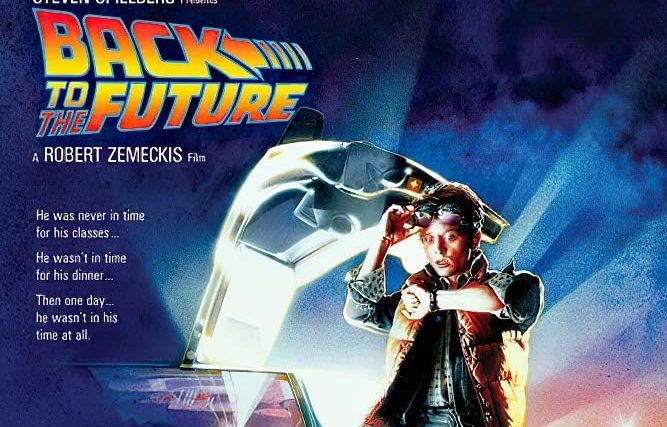
The ultimate example of pure popcorn escapism, “Back to the Future” raced to theaters in July of 1985 and has since become a cultural phenomenon. Under the magnetic direction of Robert Zemeckis, the filmmaker would go on to direct 1988’s “Who Framed Roger Rabbit,” 1994’s “Forrest Gump” and 2000’s “Cast Away.”
Even those who have never seen “Back to the Future” can still understand references to Marty McFly (Michael J. Fox) and Emmett “Doc” Brown’s (Christopher Lloyd) joyful-yet-chaotic adventures. The story centering around Marty, a 17-year-old high school student who is accidentally sent back 30 years into the past, will always have a purpose in this world, continuing to be passed down from generation to generation. The guitar-playing protagonist also deals with a variety of personal family issues at home, which have resonated with many people throughout society.
Following his trip in the DeLorean time machine to 1955, Marty needs to make sure his parents (played by Crispin Glover and Lea Thompson) fall in love while he is there, or he will cease to exist. On top of all of this, Marty also needs to go back home to 1985 and save Doc’s life, whose fate is also in his hands.
Breathlessly constructed and full of wit, Zemeckis’s film is still both highly inventive and influential.
“Back to the Future” was also a breakthrough project for Fox’s career, and Marty has been described by critics as one of the greatest movie characters of all time.
In addition, only Lloyd could have pulled off Doc’s goofy and eccentric mannerisms as the mad scientist.
“Back to the Future” was both a critical and commercial success during the summer of 1985. The film went on to become the highest-grossing movie of the year, making a whopping $388.8 million.
The hit film would lead to Part II and III, in 1989 and 1990 respectively, an animated television series that ran for two seasons (1991-1992), a Broadway musical, a theme park ride at Universal Studios, and multiple comic books, board games and video games throughout the years.
October 21 has also been dubbed as “Back to the Future Day,” referring to a critical plot point from Part II.
Further showcasing the film’s touchstone capabilities within our society, Alan Silvestri worked as the composer, and the only direction that Zemeckis gave him was “it’s got to be big.” Silvestri took that note and ran with it, using an orchestral score to contrast between a small-town setting and a large time-traveling sequence. His score has become a classic and one of the most recognizable of all time.
Silvestri would score almost all of Zemeckis’s films throughout his career, including “Forrest Gump” and “The Polar Express,” for which the composer received his two Academy Award nominations.
Bob Gale and Zemeckis penned the film’s script, with Steven Spielberg’s production company, Amblin Entertainment, financing the movie.
“Back to the Future” was nominated for numerous awards throughout 1985 and 1986, including four Academy Awards, winning one: Best Effects, Sound Effects Editing.
In 2007, the United States Library of Congress selected the film for preservation in the National Film Registry for being “culturally, historically, or aesthetically significant.”
40 years later, “Back to the Future” still takes my breath away. It’s an inventive, witty and always refreshing film to leap into the science fiction genre. Every time I watch this movie, it transports me back in time to my childhood.

 Sound Words Central
Leave a comment