

Written by John Fleming
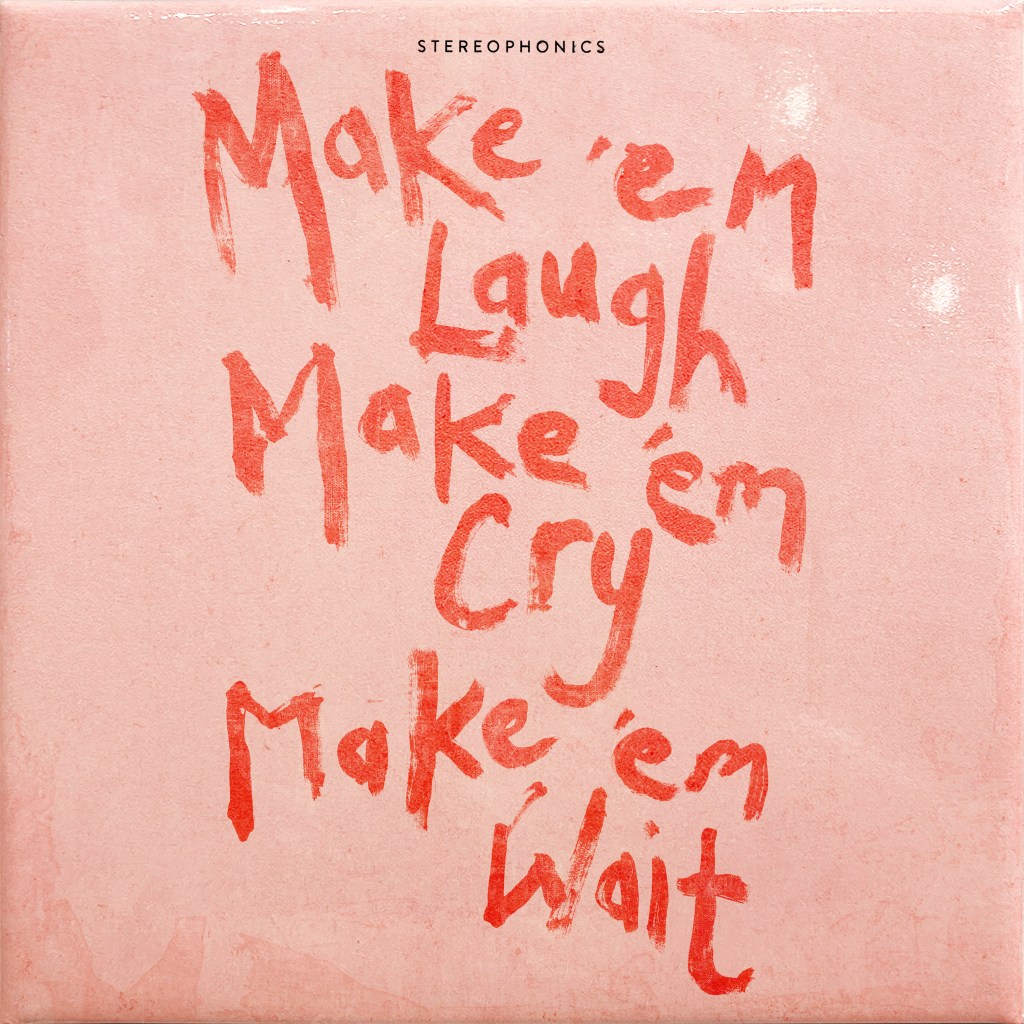
Perhaps by virtue of being Welsh rather than English, Stereophonics have largely been able to sidestep the latest fads in British rock categorization. Their sound, particularly in the early years, had a dash of Britpop, but they weren’t lumped in with that movement.
They would occasionally be designated as post-Britpop, but this was largely as a categorization of alternative rock groups from non-English Britain (Snow Patrol and Travis, notably), based on geography rather than style.
The lack of true movement has kept Stereophonics a largely British phenomenon – they have had one song chart on any U.S. charts (“Dakota” reached No. 34 on the Modern Rock Tracks chart in 2005), but were reliable hitmakers in their homeland. While this designation kept them from the global ubiquity of Oasis, Radiohead or Coldplay, it also meant that they could age gracefully; their last two albums, 2019’s “Kind” and 2022’s “Oochya!” each hit No. 1 in the U.K.
“Make ‘em Laugh, Make ‘em Cry, Make ‘em Wait” is Stereophonics’s shortest album by a fair amount, clocking in at eight tracks and just under half an hour in length. It is the kind of brisk listen more at home in the 1960s than the late-’90s and early-’00s, with which they are mostly associated. Curiously, this brevity arguably fits the music streaming era more than the often bloated albums put out by today’s major stars; artists who aim for over an hour, after all, are giving the fans who will still buy physical copies more bang for their buck. But on their 13th album, with the majority of its band members in their 50s, they seem content to just add another entry to their discography. And this lack of pretense makes for an enjoyable listen.
The Stereophonics sound is defined mostly by fairly standard rock instrumentation – guitar, bass, drums and backing but rarely lead keyboards or harmonica – but the most critical piece of the puzzle has always been the raspy, bluesy vocals of Kelly Jones. While Jones’s voice never had the range (though in his defense, few do) of Rod Stewart’s blues-rock delivery, it embodies the spirit. (Pun intended possibly; the phrase “whiskey-soaked” has been used many times to describe his voice during his career.)
The vocals arguably start, on “Make It On Your Own,” closer to the anthemic deliveries of Chris Martin or even Bono, alongside guitar work that could, cliches aside, be reasonably described as “soaring.” But on “There’s Always Gonna Be Something,” a more down-to-earth pop-rock sound is embraced.
It would be naïve, 28 years into the band’s recording career, to expect them to suddenly start recording pop hits to appeal to a U.S. audience, but the sound is not a far cry from a group like The Script, an Irish group that may never have become U2 in the United States but did have genuine pop hits.
While “Seems Like You Don’t Know Me” has a somewhat awkward synthy backbeat that doesn’t quite fit in with the bulk of the album, and “Colours of October” is a fairly forgettable ballad, the fifth track “Eyes Too Big For My Belly” has a bluesy crunch reminiscent of the Black Keys. It’s a sonically American pivot that ushers in a second half of the album that I much prefer to the first half.
It is here that the band’s origins from Cwmaman, a rural town on the outskirts of Cardiff (which, while the largest city in Wales, is considerably smaller than the band’s contemporaries from London or Manchester), really come through.
The band’s lyrics and Jones’s accent would dissuade anybody from confusing the sound as country music, but it’s not a totally incorrect assertion either. The wistful nostalgia of “Mary Is A Singer” and “Backroom Boys,” accentuated by the jangly guitar lines of Kelly Jones and Adam Zindani, along with the vocal harmonies of Zindani and Richard Jones, the band’s bassist and only other remaining original member (no relation to Kelly), give the album a sense of pleasant hopefulness even as they are ruminations on a bygone past.
On the album’s final track, “Feeling Of Falling We Crave,” is an apropos album capper, combining the first half’s sense of balladry with the second half’s rootsier identity.
I would be half-tempted to give any album that clocks in at under 30 minutes a positive review. While a great epic album can be a true classic, the degree of difficulty is a reminder that when bands were releasing half-hour jams decades ago, there was logic to it. And this is an album that is done favors by its length; had 30 minutes each been dedicated to their two speeds, it may have run together and been a bit of a slog, but as its final product, it is absolutely worth a listen. It almost by definition cannot bore you.


 Sound Words Central
Leave a comment